
TNG NFC Ring vs NFC Payment Ring: What’s the Difference and Which One Is Right for You?
21st August 2026 | by Rahim Ahmad
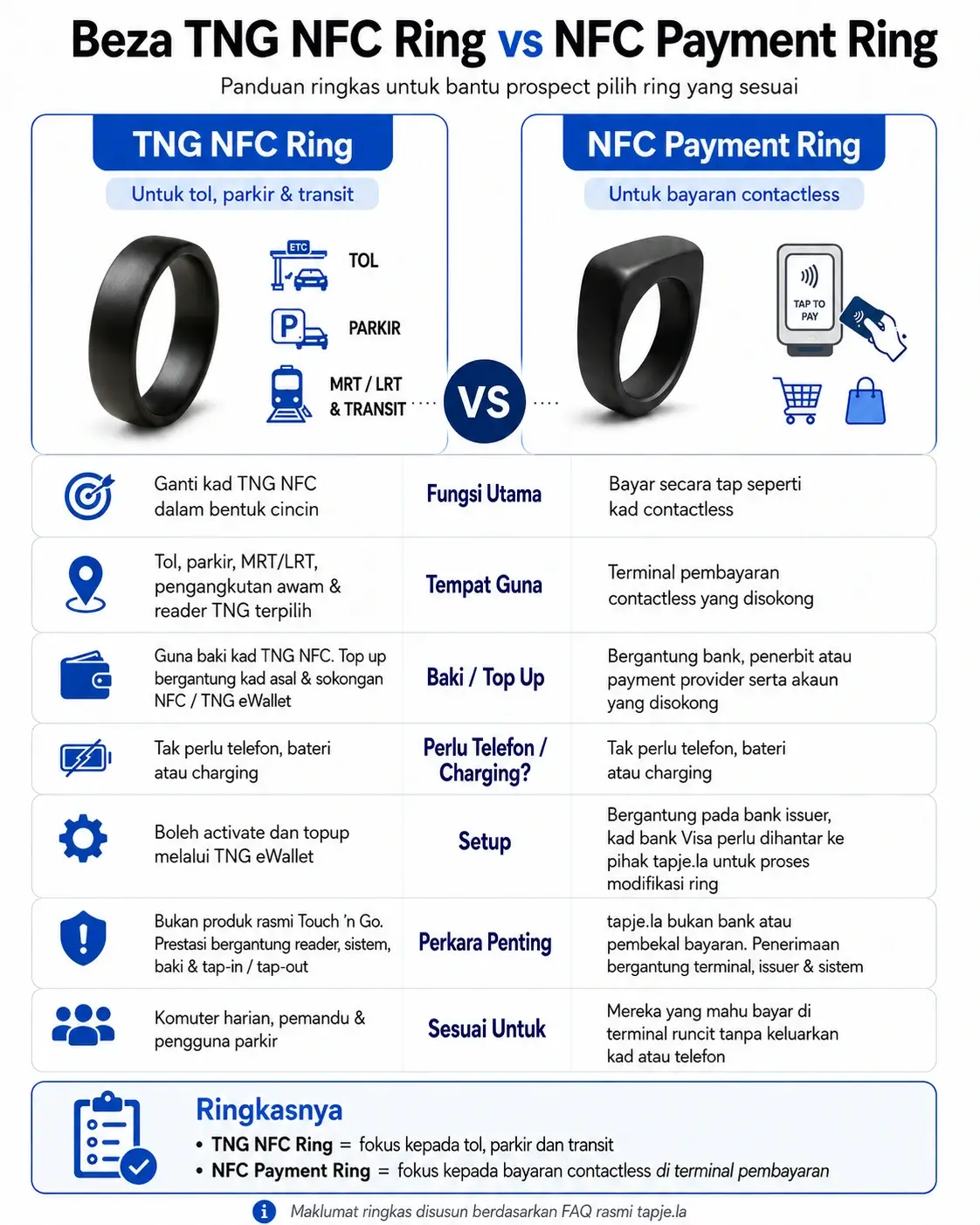
At first glance, the TNG NFC Ring and NFC Payment Ring may look almost identical.
Both are wearable rings.
Both use contactless technology.
Both do not require a battery for normal tapping.
However, their actual functions are very different.
One is designed around the Touch n Go NFC ecosystem for use cases such as tolls, parking and public transport.
The other is designed for contactless payment at supported payment terminals, similar to tapping a compatible payment card.
So before choosing a ring, the most important question is:
Where do you want to use it in your daily routine?
The Simple Difference
The easiest way to understand both products is:
TNG NFC Ring
→ Mainly for toll, parking and transit
NFC Payment Ring
→ Mainly for contactless payment terminals
Although both use NFC technology, they operate within different systems and are intended for different purposes.
Let’s break it down.
1. Main Function
TNG NFC Ring
The TNG NFC Ring is designed to provide a wearable experience similar to using a compatible Touch n Go NFC card.
Instead of taking a physical card out of your wallet, you wear the ring and tap it on a supported reader.
Typical use cases may include:
- Toll plazas
- Parking systems
- MRT and LRT
- Selected public transport
- Compatible Touch n Go readers
The idea is simple:
Your TNG NFC function, in wearable ring form.
It is mainly designed for mobility and transportation-related use.
NFC Payment Ring
The NFC Payment Ring serves a different purpose.
It is designed for contactless retail payment at supported payment terminals.
For example, you may use it at:
- Cafés
- Restaurants
- Convenience stores
- Supermarkets
- Petrol stations
- Retail outlets
- Supported contactless payment terminals
Instead of taking out a payment card, the idea is to simply bring the ring close to the supported terminal.
Card out becomes ring tap.
This makes it more suitable for users who want a more minimal everyday payment experience.
2. Where Can You Use Each Ring?
This is probably the biggest difference between the two.
TNG NFC Ring
The TNG NFC Ring depends on infrastructure that supports the relevant Touch n Go system.
Common examples include:
Toll → Parking → MRT/LRT → Transit
It is not designed to function as a Visa payment card at ordinary retail payment terminals.
So if you walk into a café and want to pay at a normal contactless card terminal, that is not the primary use case of the TNG NFC Ring.
NFC Payment Ring
The NFC Payment Ring is focused on contactless payment terminals.
It is intended for supported terminals that normally accept compatible contactless payment cards.
However, successful payment can still depend on several factors, including:
- The payment terminal
- Card issuer
- Bank
- Payment network
- Account status
- Contactless settings
- Available balance or funding source
- Acquiring system
- Security rules applied by the issuer
Because of this, the experience may not be exactly the same at every merchant or terminal.
3. What About Balance and Top Up?
TNG NFC Ring
The TNG NFC Ring uses the balance associated with the relevant Touch n Go NFC system.
Depending on the card and supported features, balance-related functions may be managed through the Touch n Go ecosystem.
Before using the ring for toll, parking or transit, users should make sure there is sufficient balance available.
So in simple terms:
TNG NFC Ring → Touch n Go balance
NFC Payment Ring
The NFC Payment Ring does not normally use the same stored-value balance as a Touch n Go NFC card.
Instead, the transaction depends on the compatible payment card, issuer, bank or payment provider associated with the ring setup.
For example, where a compatible payment card is involved, the payment source is determined by the account or balance linked to that card.
So:
NFC Payment Ring → depends on the linked payment card, issuer or payment provider
This is one of the most important distinctions between both products.
4. Do You Need a Phone to Tap?
One of the most attractive things about passive NFC wearables is that the ring itself does not normally need a battery for tapping.
For normal supported usage, both rings are designed to work without requiring you to hold a phone during the transaction.
That means you generally do not need to:
- Open an app
- Scan a QR code
- Turn on Bluetooth
- Charge the ring
- Worry about your phone battery before tapping
You wear the ring and use it on the appropriate supported reader or terminal.
However, a smartphone may still be required for certain account-management functions, balance checks, activation or other app-based features.
5. How Does the Setup Work?
TNG NFC Ring
The setup of the TNG NFC Ring is more closely related to the Touch n Go NFC ecosystem.
Once the ring has been properly prepared, supported functions may be managed through the relevant Touch n Go services.
After setup, the ring can be used on compatible readers.
The key point is that the ring is intended to work around Touch n Go-related usage, rather than general retail card payments.
NFC Payment Ring
The NFC Payment Ring requires a different setup because it involves the payment-card ecosystem.
Compatibility can depend on:
- Card type
- Card construction
- Bank
- Issuer
- Payment provider
- Payment network
- Technical compatibility
For tapje.la’s current NFC Payment Ring service, customers should first confirm whether their payment card is compatible with the available process.
Depending on the card type and issuer, the compatible card may need to be provided to tapje.la for the ring-processing procedure.
Because compatibility can vary, users should always check first before sending any payment card.
6. Which One Is Easier to Use?
Both can be easy to use.
The difference is simply what you use them for.
Imagine this daily routine:
You drive to work and arrive at a supported toll reader.
→ TNG NFC Ring
You enter a parking facility using a supported Touch ’n Go reader.
→ TNG NFC Ring
After work, you stop at a café and pay at a compatible contactless payment terminal.
→ NFC Payment Ring
Then you stop by a supermarket.
→ NFC Payment Ring
So these two products do not necessarily compete with each other.
They solve different parts of the same cashless lifestyle.
7. Who Is the TNG NFC Ring Suitable For?
The TNG NFC Ring may be suitable for users who regularly use Touch ’n Go-related infrastructure.
Drivers
If you regularly encounter supported Touch ’n Go readers, the ring can reduce the need to search for a separate card.
Parking Users
It may be useful for users who frequently enter or exit parking facilities that support compatible Touch ’n Go readers.
MRT / LRT Commuters
For users who regularly travel by public transport, a wearable form factor can provide another way to interact with supported readers.
Minimalists
If you prefer carrying fewer cards, the ring offers a wearable alternative for supported Touch ’n Go use cases.
In short, the TNG NFC Ring is mainly aimed at:
Drivers, commuters and frequent parking users.
8. Who Is the NFC Payment Ring Suitable For?
The NFC Payment Ring is more suitable for users who want a more convenient way to make everyday retail payments.
Coffee Runs
Instead of taking a card out of your wallet, simply use the ring at a supported contactless terminal.
Grocery Shopping
For small or everyday purchases, a wearable payment experience can be more convenient.
Restaurants
You can reduce the need to reach for a wallet when a compatible contactless terminal is available.
Users Who Want Less Dependence on Their Phone
You do not need to open a QR code or mobile wallet every time you make a supported payment.
Cardless Lifestyle Users
The ring can become part of a more minimal daily setup.
In short:
The NFC Payment Ring is designed for people who want everyday contactless payment in wearable form.
9. Is the TNG NFC Ring an Official Touch n Go Product?
No.
tapje.la TNG NFC Ring is not an official Touch n Go product, and tapje.la is not affiliated with or endorsed by Touch n Go.
It is an independent wearable product developed to provide an alternative form factor for compatible use cases.
Performance may vary depending on factors such as:
- Reader type
- Reader sensitivity
- Touch n Go system behaviour
- Available balance
- Tap-in and tap-out status
- Ring position during tapping
- Environmental or technical conditions
Because of these variables, the experience may not be identical across every reader.
10. What About the NFC Payment Ring?
For the NFC Payment Ring, it is equally important to understand that:
tapje.la is not a bank, Visa, card issuer or payment provider.
tapje.la provides the wearable ring and the related product-processing service.
Transaction acceptance still depends on external payment systems, including:
- Issuing bank
- Card issuer
- Payment network
- Merchant terminal
- Acquiring bank
- Account status
- Card status
- Security controls
- Technical compatibility
This means not every payment card or every contactless terminal will necessarily behave in exactly the same way.
TNG NFC Ring vs NFC Payment Ring
| Feature | TNG NFC Ring | NFC Payment Ring |
|---|---|---|
| Main Purpose | Toll, parking and transit | Contactless retail payment |
| System | Touch ’n Go NFC ecosystem | Depends on payment card / payment system |
| Where It Is Used | Supported Touch ’n Go readers | Supported contactless payment terminals |
| Balance / Funding | Touch ’n Go balance | Depends on card issuer or payment provider |
| Phone Required to Tap? | No | No |
| Battery / Charging Required? | No | No |
| Primary Use Case | Mobility and transportation | Retail payment |
| Best For | Drivers, commuters, parking users | Users who want a more cardless payment experience |
Which Ring Should You Choose?
The answer depends on your daily routine.
Choose the TNG NFC Ring if you mainly use:
Toll + Parking + MRT/LRT + Transit
It is more suitable if your everyday routine revolves around commuting, driving and Touch ’n Go-related readers.
Choose the NFC Payment Ring if you mainly want:
Contactless payment at supported payment terminals
It is more suitable if your priority is making everyday retail payments without constantly taking out your physical card.
Can You Use Both?
For some users, the most practical setup may actually be to use both rings because they serve different purposes.
For example:
Toll → TNG NFC Ring
Parking → TNG NFC Ring
MRT/LRT → TNG NFC Ring
Coffee → NFC Payment Ring
Lunch → NFC Payment Ring
Groceries → NFC Payment Ring
In this setup, one ring handles mobility while the other handles retail payment.
That creates a broader wearable experience throughout the day.
It Is Not Just About Replacing a Card
The idea behind wearable NFC technology is not simply to move a card into a ring.
It is about changing how users interact with everyday systems.
Instead of constantly thinking:
“Where is my card?”
or:
“Where is my phone?”
the interaction becomes more natural.
You are already wearing the ring.
When you reach the correct reader or terminal, you simply tap.
That is the real benefit of wearable technology:
Less friction in everyday routines.
Final Summary
Although the TNG NFC Ring and NFC Payment Ring may look similar from the outside, they are designed for completely different purposes.
The easiest way to remember the difference is:
TNG NFC Ring = for mobility and transit.
NFC Payment Ring = for contactless payment.
If your daily routine involves tolls, parking and public transport, the TNG NFC Ring may be more relevant to you.
If your priority is making supported retail payments without constantly taking out a physical card or phone, the NFC Payment Ring may be the better option.
And for users who want a more complete wearable experience, both rings can complement each other.
The most important thing is not which ring looks better.
It is choosing the ring that matches how you actually live and pay every day.
Important Disclaimer
tapje.la is an independent wearable technology brand and is not affiliated with, endorsed by, sponsored by, or an official product of Touch n Go, TNG Digital, Visa or any banking institution.
Touch n Go, TNG eWallet, Visa and other trademarks mentioned belong to their respective owners.
Compatibility, reader performance and transaction acceptance may vary depending on card type, issuer, payment provider, payment network, terminal, reader, account status, available balance and other technical conditions.
Customers should verify compatibility and understand the applicable requirements before using or submitting any payment card for a related service.